
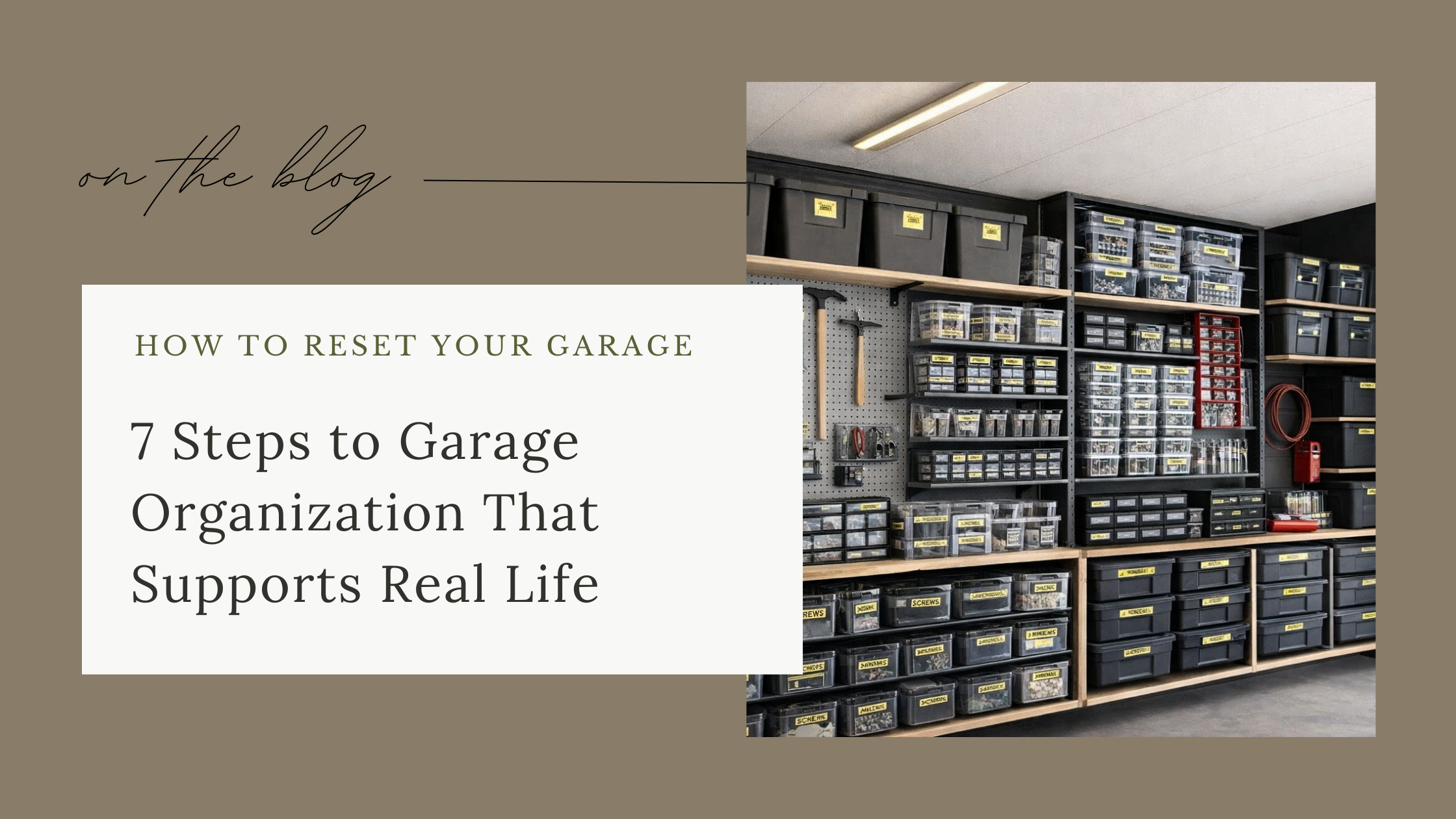
Does your garage add friction to your day before you’ve even had a chance to catch your breath? When the space meant to support daily life feels cluttered, chaotic, or unfinished, it quietly contributes to mental overload—especially for working moms juggling schedules, responsibilities, and constant decision-making.
This post offers a thoughtful approach to resetting your garage with intention. Grounded in the Harmony by Design™ method, it outlines how calm, step-by-step organization can restore function, clarity, and ease—without pressure or perfection.
For transparency, some links in this post are affiliate links. As an Amazon Associate, we may earn a small commission—at no cost to you.
The real problem: it’s not a messy garage—it’s a garage that no longer supports your life
Garages rarely become overwhelming all at once. They slowly absorb the overflow of everyday life—sports gear, bulk purchases, seasonal décor, unfinished projects—until the space loses clarity and purpose.
When a garage lacks intentional systems, it often leads to:
- Mental overload and decision fatigue
- Inefficient storage that makes simple routines harder than they should be
- A lingering sense of being behind before the year even begins
A successful garage reset isn’t about clearing everything out. It’s about simplifying with purpose and creating systems that align with how your life functions today.
Step 1–3: Intentional design solutions for an organized garage system
1. Discover how your garage needs to function
Before touching a single bin or shelf, clarity comes first. A supportive garage starts with understanding how the space is used day to day—parking, storage, school gear, projects, outdoor equipment, or household overflow.
Defining these needs allows the garage to be divided into purposeful zones, such as:
- Daily grab-and-go items near the house entry
- Seasonal and long-term storage kept higher or further back
- Activity-based zones for tools, sports gear, or projects
This step ensures the garage is designed intentionally, not reactively.
2. Simplify with purpose, not pressure
Once zones are defined, the next step is gentle simplification. This phase focuses on reducing what no longer supports your current life—not forcing decisions or striving for minimalism.
Items are sorted by use and relevance, creating space for what truly matters. When every item has intention, the garage becomes lighter, clearer, and easier to maintain.
Simplifying with purpose lays the foundation for a decluttered garage that feels calm rather than stripped down.
3. Design the flow using vertical space and access levels
A functional garage layout prioritizes ease and accessibility. Storage should feel intuitive—especially in busy households where time and energy are limited.
The most effective organized garage systems follow a simple access hierarchy:
- Everyday items stored at eye level or below
- Occasional-use items stored higher
- Long-term storage reserved for ceiling or top shelving
To support zone-based garage storage solutions on the wall (instead of the floor), consider:
- Slatwall panels on Amazon: https://amzn.to/4jjXZfr
- Slatwall hooks and accessories on Amazon: https://amzn.to/4jDD9YJ
- Metal pegboard panels on Amazon: https://amzn.to/44TjcXE
- Pegboard hook sets on Amazon: https://amzn.to/49lsRaP
Smart upgrades for overhead and vertical storage include:
- Overhead storage racks: https://amzn.to/3YCoSSp
- Heavy-duty garage shelving units: https://amzn.to/4pj9ULI
- Wall-mounted garage shelving: https://amzn.to/4qs7Gur
Wall systems, shelving, hooks, and overhead racks allow the garage to function vertically, keeping floors clear and pathways open. When items are placed where they’re naturally used, daily routines become smoother and less demanding.
Step 4–5: Storage solutions that support real life
Once the flow is established, the right garage storage solutions bring structure and sustainability.
We recommend:
- Choosing one to two tote styles for most categories
- Using clear bins where visibility helps, and opaque bins where visual quiet matters
- Labeling by broad, maintainable categories—not hyper-specific systems you’ll abandon
Reliable tote options for a garage reset:
- Heavy-duty storage totes: https://amzn.to/3KR6aTO
- Stackable latching storage bins: https://amzn.to/45leSQY
- Clear latching bins: https://amzn.to/44POjmU
For small items that tend to create constant friction—batteries, screws, lightbulbs, command hooks—a dedicated micro-storage station makes a noticeable difference:
- Small-parts drawer cabinets: https://amzn.to/4jhDCj3
- Toolbox organizer trays: https://amzn.to/4qw96nI
Standardized bins, shelving, and containers help systems stay consistent. Labels reinforce clarity, so everyone in the household knows where things belong—without needing constant resets.
Clear containers work well for seasonal and category-based storage, while closed storage helps reduce visual noise. The goal is a garage that feels orderly, accessible, and easy to maintain week after week.
The emotional payoff: what a harmonious garage gives you back
A thoughtfully organized garage doesn’t just look better—it changes how your home feels.
Many homeowners notice:
- Calmer mornings with fewer obstacles and less rushing
- Fewer moments of mental drain caused by searching or re-deciding
- A renewed sense of ease and momentum instead of constant catch-up
When the garage is aligned with daily routines, it quietly supports your life in the background—so you can focus on what matters most.
A garage reset that’s designed to last
If your garage feels heavy or unfinished, it isn’t a reflection of failure. It’s simply a sign that your life has evolved—and your space needs to evolve with it.
At Declutter + Design Co., every garage project is guided by a thoughtful process of discovery, simplification, intentional zoning, and sustainable systems. This approach allows us to create garage organization solutions that support real life with clarity, flow, and calm—without pressure or perfection.
As a professional home organizing team serving the Fort Worth area, our approach is empathetic and design-forward—where thoughtful design brings harmony to everyday life. You can explore our full range of offerings on our
Services page: https://declutteranddesignco.com/services/
Ready for a garage reset that brings clarity and ease?
Leave a Reply